
Much of what we’re taught early in photography is about control.
Keep things sharp. Use a shutter speed fast enough to freeze movement. Avoid anything that might be seen as a technical flaw. If we do it well, the photograph becomes a clear, accurate description of what was in front of us.
That’s a useful place to begin.
But it can also narrow what we allow the camera to do.
Think about shutter speed for a moment. In practice, it’s often adjusted to eliminate movement—either from the subject or the camera itself. If the light is low, we compensate: a wider aperture, a higher ISO. The goal is to maintain control.
But each of those decisions carries a trade-off.
There is another option, though we rarely consider it. Rather than correcting for movement, we can allow it to remain. Instead of insisting on a faithful rendering of the scene, we allow the camera to describe something else—not just what was there, but what it felt like to be there.
Ernst Haas, often considered one of the fathers of expressive colour photography, created much of his work in the 1950s and early 60s using early Kodachrome, often handheld. With an effective ISO of 10, the technical constraints were severe. But rather than working against them, he used them. The result is a body of work where time doesn’t simply stop—it accumulates. A photograph becomes less a frozen instant and more a gathering of moments (Ernst Haas).
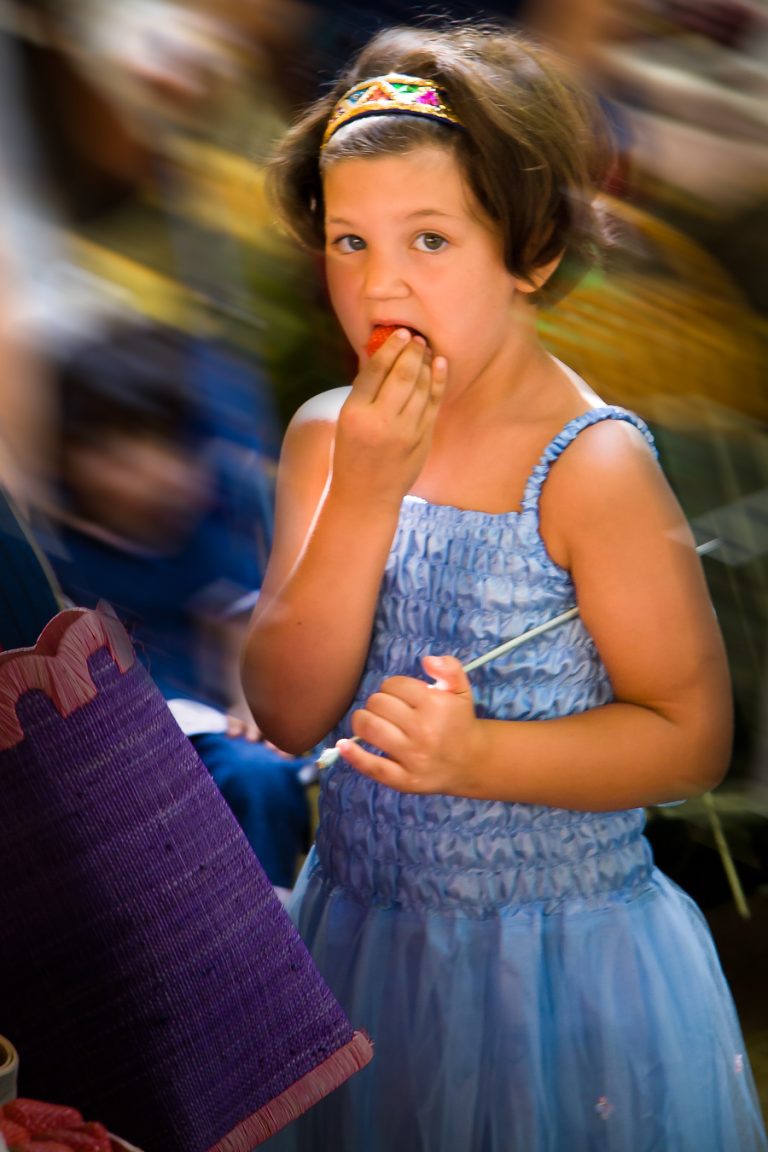
The photograph at the top of this post was made in a busy market in Aix-en-Provence. People were moving constantly through the frame—passing behind the young girl, stopping briefly, then moving on. At a typical shutter speed, all of that would resolve into a clean, readable, and very busy background.
Instead, by choosing a slower shutter speed, the movement was allowed to remain. The background softens into a blur of morning shoppers. The young girl becomes an island of patience as she waits for her mother. She is not entirely still—there is a gentle movement—but in that moment, she seems removed from everything around her. What results isn’t quite what the eye sees. It’s something else. The scene isn’t frozen so much as gathered. Time doesn’t stop—it accumulates. The girl’s relative stillness becomes more pronounced as everything around her continues to move.
It’s a small shift, but an important one.
We often think of the camera as a tool for correcting the world—bringing it into focus, stabilizing it, making it behave. But the camera has never really seen the world the way we do. It stretches time, compresses space, and brings together things we would normally experience separately.
Those differences are easy to treat as problems.
But they’re also where expressive photography begins.
So rather than starting with the question, “How do I fix this?” it might be worth asking something slightly different:
What is the camera already doing?
And is there something there I can use?

Thoughtful discussion is welcome. Comments may be moderated for clarity and relevance.